
Resurfacing Stamped Concrete on the Gold Coast: What’s Actually Possible
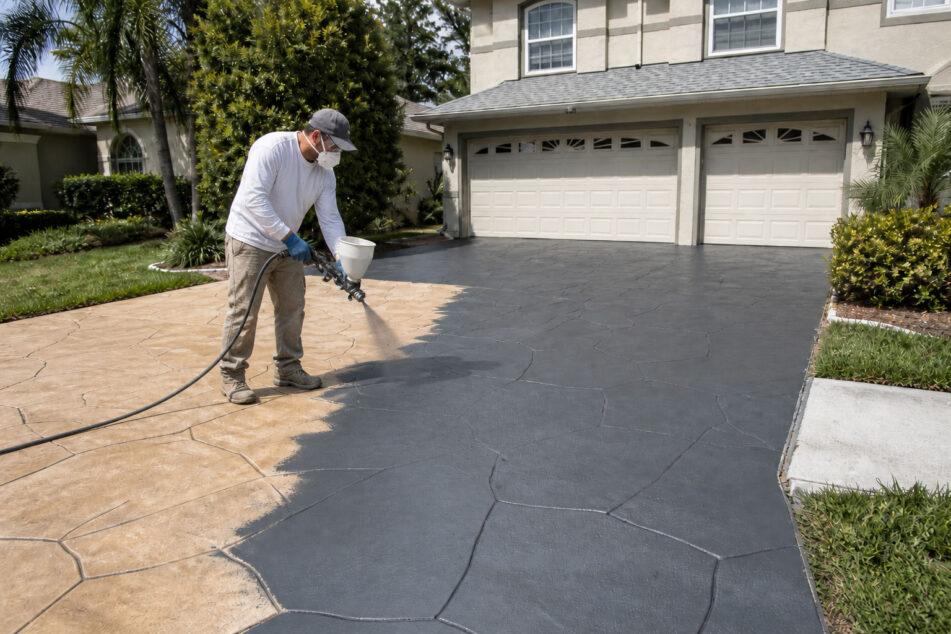
If your stamped concrete patio or driveway is faded, cracked, or just looks dated, you don’t need to rip it up. Most stamped concrete on the Gold Coast can be resurfaced — but the part most homeowners don’t realise is this: resurfacing covers the stamped pattern. You’re choosing a new finish on top, not preserving the old one.
That’s actually good news for most people I quote. The reason their stamped concrete looks tired is usually the pattern itself — UV-faded colours, worn-out texture, and a design that hasn’t aged well. A fresh covercrete overlay gives them a clean slate.
Spray Your Concrete is a Gold Coast family business. We’ve been resurfacing concrete since 2012 (QBCC #1205294), and I’ve spent 20 years on the tools doing this work. Here’s what’s possible when you resurface stamped concrete, what it’ll look like afterwards, what it costs, and what to watch for before you commit.
Free On-Site Quotes, Gold Coast to Redlands
We come out, look at the surface, and give you a written price. No charge, no obligation.
Stamped concrete vs stencilled concrete — they’re not the same thing
This trips up a lot of homeowners, so worth getting straight before we go further.
Stamped concrete is when wet concrete is poured and then mats are pressed into it during the pour to leave a pattern — usually a stone, slate, or brick look. The pattern is part of the original slab.
Stencilled concrete is different. A pattern is laid into a sprayed overlay during a resurfacing job. The pattern lives in the coating, not in the slab underneath, which is why stencilled concrete can be resurfaced with a fresh colour or a new pattern later on. We service stencilled concrete; we don’t pour stamped slabs.
This matters because resurfacing a stamped slab means moving away from a stamped finish. The new surface — a covercrete overlay — sits on top of your existing stamped concrete and covers the original mat pattern entirely. The look you end up with is whatever finish you choose for the overlay, not the stamp you started with.
Why stamped concrete starts to look bad
There are three things I see on almost every stamped concrete job I quote on the Gold Coast.
UV fade is the big one. The integral colours and surface stains used in stamped concrete take a beating from full sun, and after eight or ten years most jobs have faded to a washed-out version of what they started as. Coastal homes get it worse — salt air doesn’t help.
Cracking is the second. Stamped concrete cracks the same way any concrete cracks — slab movement, sub-base settlement, or hairline shrinkage. The cracks tend to show up more on stamped because the pattern lines draw your eye to anything that breaks the rhythm.
And then there’s the design itself. A stamp pattern that looked sharp in 2010 often looks dated now. That’s not the concrete failing — it’s the style ageing.
Patch repairs and recolouring rarely fix any of these properly. They mask the problem for a year or two, then it comes back. Resurfacing is the more permanent answer.
Can stamped concrete be resurfaced or refinished?
Yes, in almost every case. The slab needs to be structurally sound — meaning no major movement, no severe deep cracking, no slab sinking — but the stamped pattern itself isn’t an obstacle. We work over the top of it.
The catch is the one I mentioned in the intro: you’re not refinishing the stamp pattern. You’re covering it and choosing a new finish. Most homeowners I talk to are fine with this once they see the options — the stamp was the thing they wanted gone in the first place.
If your slab has a serious structural problem, resurfacing won’t fix that. A slab that’s still moving will telegraph cracks straight up through any overlay within a couple of years. I check for that on every quote and tell people honestly if their slab needs to be addressed first.
What your new finish can look like
Once we resurface stamped concrete, you’ve effectively got a fresh canvas. There are three directions most homeowners go.
A textured finish — broomed, dragged, flecked, or stone-look — is the most common choice for replacing an aged stamp. Texture hides any minor surface imperfection underneath, and a flecked finish in particular sits well on driveways because it doesn’t show tyre marks the way a flat colour does.
Professional stencil concrete resurfacing is the closest you’ll get to keeping a patterned look when resurfacing an existing stamped slab. We can lay a cobblestone, brick, tile, or custom stencil into the wet covercrete during the resurfacing, and it’ll look more current than your old stamp. The pattern lives in the new overlay rather than the old slab.
A plain coloured covercrete is the third option, and it’s underrated. A clean single colour in a modern grey or stone tone makes an old patio look brand new without the busyness of a pattern.
On colour — for non-stencil jobs, we use Shieldcoat Step Safe Heavy Duty, which comes in 33 standard colours and can be tinted to almost anything else. There are covercrete colour options worth looking through before the on-site quote so you’ve got a sense of what you’re after.
How we resurface stamped concrete — the process
Whether the new finish is textured, stencilled, or plain, the application follows the same five steps. This is the part where prep matters more than anything else — a resurfacing job is only as good as the surface it’s bonded to.
First, we pressure-wash the existing stamped slab to strip dirt, grease, and any loose surface material. Stamped concrete catches grime in the texture lines, so this stage takes longer than people expect.
Second, we repair any cracks or surface damage in the slab. Hairline cracks get filled; anything wider than about 3mm gets cut out and patched properly before we coat over it.
Third, a bonding primer goes down. This is what makes the overlay grip the existing slab — without a proper primer, no resurfacing system holds.
Fourth, three coats of the chosen system go on. For non-stencil finishes we use Step Safe Heavy Duty (Shieldcoat) — a P5 anti-slip rated coating with a 7-year manufacturer warranty against flaking, peeling, and cracking. For stencilled finishes we use Dulux Avista, which is the better-suited system for stencil work. If we’re laying a stencil, the pattern goes in at this stage.
Fifth, two coats of clear sealer finish the job. The sealer is what protects the surface from UV, stains, and wear. It’s also what gives the finish its slip resistance on patios and pool surrounds.
If you want a deeper read on the application side, I’ve written a more detailed covercrete application guide that walks through each stage.
Stamped concrete resurfacing cost on the Gold Coast
A standard stamped concrete resurface runs from $50 per square metre. For a typical 30m² patio, that’s around $1,500. For a driveway in the 60–80m² range, you’re looking at roughly $3,000 to $4,000.
That’s a fraction of what it costs to demolish and re-pour a stamped slab — which is the alternative most homeowners are weighing it against. Slab replacement on a driveway can run three to four times the resurfacing price once you factor in demolition, removal, and a new pour.
Where the price moves up from the $50/m² starting point: heavily damaged slabs that need extensive crack repair, large jobs that require additional substrate prep, stencilled finishes (slightly more than plain or textured because of the pattern work), and harder-to-access areas. We give a fixed written quote on every job after the on-site assessment — no surprises after we start.
What to check before you commit to resurfacing
Two things I tell every homeowner to look at before they book.
Check the slab for movement. Stand back and look across your stamped concrete. If you can see lines where two sections have shifted vertically, or if a crack runs the length of the slab and the two sides sit at different heights, the slab is moving. That needs to be addressed first — resurfacing won’t hold over a moving slab.
Be sure about the new finish. Resurfacing is a one-way trip. Once we lay the overlay over your stamped slab, the stamp pattern is gone for good. Most people find this freeing — the stamp was the thing they wanted to be rid of — but it’s worth being clear about what you want the new surface to look like before we start.
Where to from here
Resurfacing is the practical way to deal with old stamped concrete on the Gold Coast or Redlands. It costs less than replacement, the finish lasts 10–15 years on a properly prepared slab, and you end up with a surface that looks current rather than dated.
If you’re not sure whether your stamped slab is a candidate, the simplest thing is to have someone come and look at it. We do free on-site quotes across the Gold Coast to Redlands — I’ll tell you straight whether resurfacing is the right call for your slab, what finish I’d recommend, and what it’ll cost. You can read more about our concrete resurfacing service or contact us for a quote.

