
Decorative Flake Epoxy Flooring: Colours, Finishes and How It’s Installed
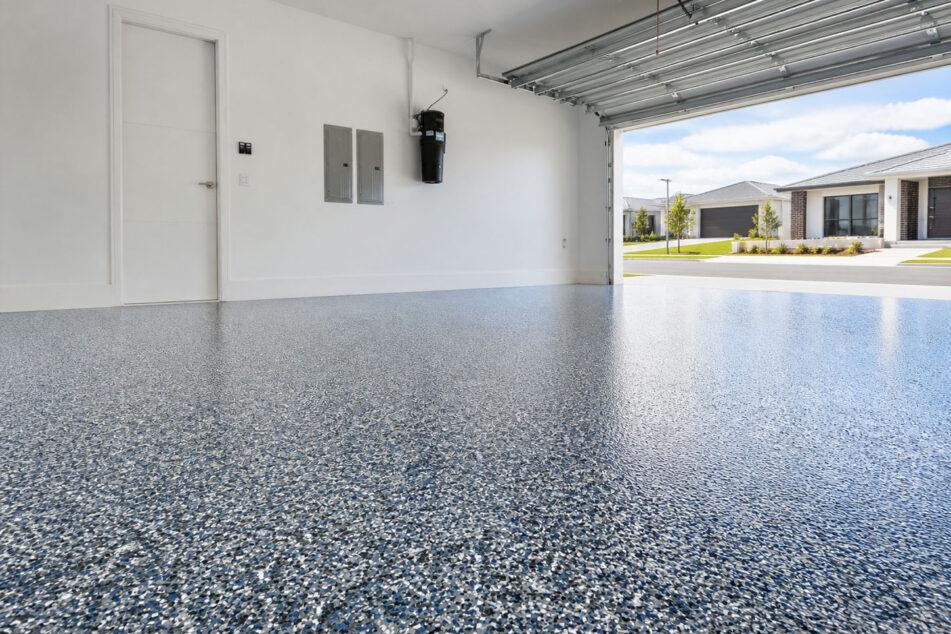
Most homeowners who ring me about a fancy garage floor are picturing the same thing — that speckled, multi-coloured finish you see in display homes and high-end workshops. They just don’t always know it’s called flake. Properly, it’s epoxy flake flooring: a multi-layer system where coloured vinyl chips are broadcast into a wet epoxy basecoat and sealed under a clear topcoat.
I’ve been laying decorative flake epoxy on Gold Coast to Redlands jobs for years now, mostly in garages and alfresco areas, but also in workshops, showrooms, and the occasional home gym. At Spray Your Concrete, we install the Durable Concrete Coatings Colour Flake™ system, which offers around fifty standard blends across four loose groupings and plenty of room to tailor a blend to the space.
This article walks through what flake epoxy actually is, where it works best, what the two colour ranges look like, how the install runs on site, and how flake compares to a solid epoxy floor — so you’ve got a clear picture before you book a quote.
Free On-Site Quotes, Gold Coast to Redlands
We come out, look at the surface, and give you a written price. No charge, no obligation.
What Decorative Flake Epoxy Flooring Actually Is
Decorative flake epoxy is a multi-layer floor coating where coloured vinyl flakes are broadcast into a wet epoxy basecoat, then sealed under a clear UV-stable topcoat. The result is a hard-wearing, slip-resistant, seamless floor with a speckled finish — used on garages, alfresco areas, workshops, and showrooms.
The “flakes” are pigmented vinyl chips, not glitter, not sand, not paint additive. They come in different sizes and colour combinations, and they sit suspended between the basecoat and the topcoat — which is why a properly installed flake floor looks like one continuous surface rather than something painted on top of the slab.
The system itself runs in layers. A primer goes down first to bond to the prepared concrete. Then the coloured epoxy basecoat is rolled on, and while it’s still wet, the flakes are broadcast across it by hand. Once it cures, the loose flakes are vacuumed off, and a clear topcoat goes over the top to lock everything in. Flake is one option within our broader epoxy flooring service — the other main option is solid epoxy, which is a single colour with no flakes. More on that comparison later in the article.
Where Flake Epoxy Works Best
Most flake epoxy flooring jobs I quote are residential garages or alfresco areas, but I’ve laid plenty in workshops and small showrooms too. The four spaces it suits best, and why:
- Garages. A flake garage floor is hard-wearing under cars, dragged toolboxes, and hot-tyre pickup, and the texture hides the small imperfections that show up in any older slab. The seamless surface cleans up faster than a painted or bare-concrete garage floor, which is what most homeowners notice first. There’s a deeper guide to epoxy garage flooring on the service page, and a full breakdown of how the system holds up in our guide to epoxy garage flooring on the Gold Coast.
- Alfresco areas. This is where the slip-resistant texture earns its keep. The broadcast pattern gives the floor enough grip to be safe in wet conditions, which matters around outdoor kitchens and pool-adjacent decks. The polyurethane topcoat is UV-stable, so flake works outdoors — but worth knowing, under the hard Gold Coast sun, the topcoat eventually needs refreshing.
- Workshops. Flake is hard-wearing, and its abrasion resistance handles dropped tools, sliding bench gear, and high-traffic footwear better than plain-coloured floors. An epoxy flake floor also hides imperfections in older workshop slabs that have seen years of stains and chemical drips.
- Showrooms and retail. Flake suits showrooms where you want decorative impact and texture underfoot. For a sleek, minimalist showroom, though, solid epoxy or polished concrete is sometimes the better look — flake has visual movement that doesn’t always suit a quiet space.
Colour Flake® Colour Options
There is no shortage of epoxy flooring flake options. Colour Flake® is the system we use for almost every epoxy flake floor on the Gold Coast — around fifty standard blends, all sitting in one palette. Each blend is a mix of pigmented vinyl chips broadcast over a coloured basecoat, and the chip sizes are roughly consistent across the range, so flake size is something you adjust through highlights and custom blending rather than by picking a different blend. Rather than running through every name on the chart, here’s how I usually break down the epoxy floor colours when I’m pulling sample cards out for a quote.
- Mineral and earth tones — Bluestone, Carbonite Grey, Salt & Pepper, Ironstone, Espresso, Moonlight. The mineral palette is the architectural side of the range. Tonal flake blends like these suit a contemporary garage, a showroom, or any space where the floor needs to read clean and quiet.
- Dedicated greys — Anchor Grey, Domino Grey, Harbour Grey, Seal Grey, Smoke Grey, Steel Grey, Thunder Grey, and a few others sit in the “Shades of Grey” group. If you’re matching grey cabinetry, grey walls, or polished-look interiors, this is where I usually start.
- Character blends — Kookaburra, Kangaroo, Wedgetail, Bilby, Sugar Glider, Platypus. The Australian fauna names. These run on a warmer palette with more colour variation across the chips, and they’re popular for alfresco areas and workshop floors where the owner wants the floor to have a bit of personality rather than disappear.
- Extension blends — American Granite, Australian Camel, Black Smoke, Denim Light, Firefox, Moroccan Tan, Volcano Ash. A smaller set of standard blends that sit outside the main groups and tend to pull from a more global colour palette.
For something different again, Durable Concrete Coatings also makes DuraStone Flake® (stone-look chips in two series — names like Slate, Onyx, Sand Stone) and Mica Flake™ (gold and bronze metallic highlights). Both sit at a higher price point than the standard Colour Flake® blends, but they’re genuine options if you’re chasing a polished-stone or metallic epoxy finish rather than a speckled epoxy flooring flake look.
The final selection occurs at the on-site consultation. I bring physical sample cards, we look at them in your space against your walls and existing finishes, and you can see how the epoxy flakes and flake size actually read on the floor. Photos on a screen don’t translate accurately, and a blend that looks one way under shop lighting reads completely differently in the sun.
View the available colour charts.
How Flake Epoxy Is Installed — The Six-Step Process
A proper flake epoxy flooring install runs over two to three days on site, plus cure time before you can drive on it. Here’s how the job actually goes from a bare slab to a finished floor.
- Step 1 — Diamond grinding. The slab is mechanically ground with a diamond-tooled grinder before anything else happens. Mechanical surface grinding opens the concrete so the primer can bond into the slab rather than sitting on top of it. This is the single most important step in the whole process, and it’s the step DIY kits skip — which is why DIY epoxy floors lift, peel, or hot-tyre pickup within a year.
- Step 2 — Primer. Once the slab is ground and vacuumed clean, a bonding primer goes down. The primer is what physically locks the epoxy basecoat to the concrete. We let it cure before moving on.
- Step 3 — Epoxy basecoat. The coloured epoxy basecoat is rolled across the floor in your chosen base colour. This is the layer the flakes sit in, so timing matters — the flakes need to go on while it’s still wet.
- Step 4 — Flake broadcast. While the basecoat is still wet, the flakes are broadcast across the floor by hand. This is the step that turns a coloured epoxy floor into epoxy flooring with flakes. Keeping the broadcast even is the part that takes years to learn — you’re aiming for full coverage with no thin patches and no clumping, and you only get one shot at it.
- Step 5 — Vacuum. Once the basecoat has cured with the flakes locked in, the loose flakes that didn’t bed into the resin are vacuumed off. This leaves a clean, even flake surface ready for the topcoat.
- Step 6 — Polyurethane topcoat. Two coats of aliphatic, non-yellowing, single-pack moisture-cure polyurethane go over the top as the final clear topcoat. This is what gives the floor its UV stability, its chemical resistance, and its slip-resistant texture — and it’s why the floor doesn’t yellow over the years.
The whole job takes two to three days on most residential garages and alfresco areas. After the final topcoat goes down, the floor needs cure time before it sees traffic — usually 24 hours for foot traffic and 5–7 days before you can drive on it.
Spray Your Concrete is a licensed installer (QBCC Licence #1205294), and we run the same six-step process on every Gold Coast flake epoxy flooring job, whether it’s a single garage or a commercial showroom.
Flake vs Solid Epoxy — Which Finish Is Right for Your Space?
The two main options for an epoxy garage or alfresco floor are an epoxy flake floor — a coloured basecoat with vinyl flakes broadcast over it — or solid epoxy, also called plain epoxy, which is a single colour with no flakes at all. Both are durable. The decision is mostly about how the floor looks and how forgiving it is.
Flake hides imperfections. The broadcast pattern breaks up the eye, so small dents, patches, and surface variations in the slab disappear under the speckle. It also gives natural slip resistance through texture, and it adds visual interest that solid epoxy can’t. The trade-off is that on big open-plan floors, you can sometimes read the broadcast pattern across the room, and a heavy full-flake broadcast isn’t always the right look for a sleek modern showroom — that’s where a partial-flake broadcast, or solid epoxy, is sometimes the better call.
Solid epoxy is cleaner and cheaper. It reads more like a coloured floor than a decorative one, which suits a minimalist showroom or styled alfresco where the floor is meant to sit quietly. The downside is it shows everything — tyre marks, scuffs, drips, and any imperfections in the slab underneath all read on a plain epoxy floor more readily than on a flake one.
Indicative pricing from our epoxy flooring service: solid epoxy starts from $55/m², and decorative epoxy flooring with flakes starts from $77/m². Final price depends on slab condition, square metreage, and the blend you choose.
The pattern I usually see: for a working garage, the flake is worth the extra — it hides imperfections, it’s more forgiving day to day, and it’ll still look right after years of cars driving in and out. For a small showroom or a styled alfresco, it depends on the look you want.
If you’re not yet sure whether epoxy is the right call at all — versus, say, resurfacing the concrete instead — it’s worth reading our comparison of epoxy versus concrete resurfacing before booking a quote.
Care, Cleaning and How Long Flake Floors Last
Day-to-day, an epoxy flake flooring system is one of the lower-maintenance floors you can have. A sweep and a damp mop with mild detergent is enough — the seamless finish has no grout lines or grooves to trap dirt, so it cleans up quickly and stays looking even. That low-maintenance side of it is one of the reasons flake suits busy garages and high-traffic alfresco areas.
Lifespan depends on where the floor is. A properly installed flake floor will hold up for 10+ years indoors before the polyurethane topcoat needs a refresh. Outdoors under direct sun, the topcoat refresh window is shorter — UV is the main thing that wears the protective layer, and it’s why epoxy driveways in full Gold Coast sun usually only need a recoat rather than a full re-lay. Worth knowing the flake itself doesn’t fade; it’s the clear topcoat above it that does the work and eventually wears.
What does damage it: concentrated solvents (paint stripper, brake fluid, strong acids) sitting on the surface for extended periods, and sharp metal dropped from height. The abrasion resistance is high under normal use — cars, foot traffic, dragged furniture, dropped tools — but a sharp corner falling onto the floor can still chip the topcoat.
Frequently Asked Questions
Get a Free On-Site Quote
If you’re seriously considering a flake floor, the most useful next step is having someone bring the sample cards to your space and look at the blend options in your actual light, against your walls. We’re a family-owned Gold Coast business servicing the Gold Coast to the Redlands, and we do free on-site quotes on every epoxy floor we install. Call 1800 954 449 or send us your details through the contact form.

