
Concrete Patio Resurfacing on the Gold Coast: Finishes, Costs and Process
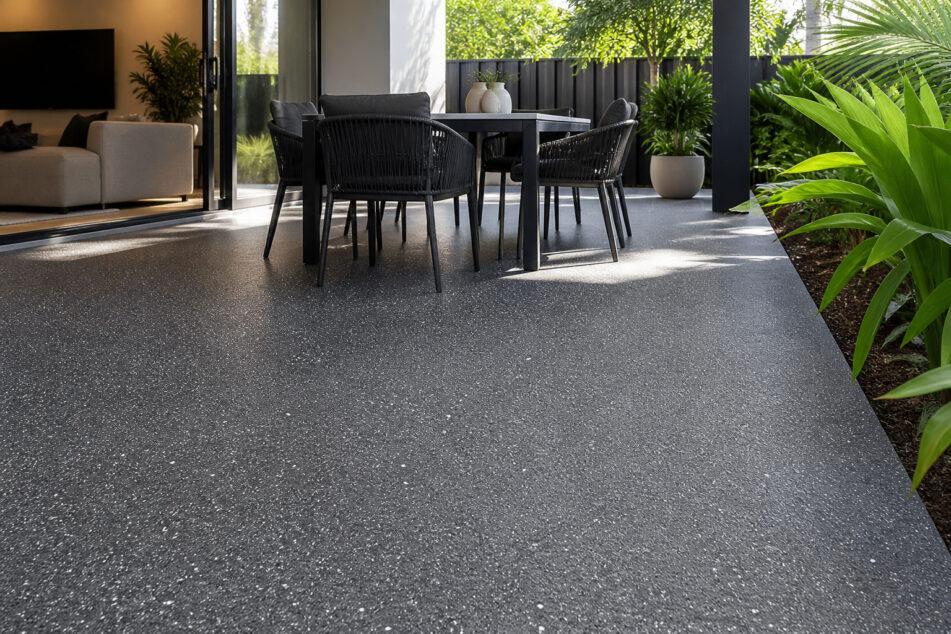
Most of the concrete patio resurfacing jobs I quote on the Gold Coast to Redlands start the same way. A homeowner is standing on a tired-looking slab — sun-faded, mould-stained, or stencilled in a 1990s pattern that hasn’t aged well — and they want to know if the existing concrete slab can be saved without ripping it up. Nine times out of ten, the answer is yes.
Resurfacing is a thin coating sprayed over the existing concrete to give you a clean, slip-resistant finish on your alfresco or entertaining area without the cost or mess of demolition. In twenty years on the tools, I’ve handled enough concrete patio makeovers on the Gold Coast to Redlands to know the slab usually has more life left in it than homeowners expect. Patios are one of the jobs we get asked about most.
This article covers what’s involved when you resurface a concrete patio — finish options, costs, slip resistance and heat in our climate, the process, and when resurfacing isn’t the right call.
Free On-Site Quotes, Gold Coast to Redlands
We come out, look at the surface, and give you a written price. No charge, no obligation.
What Patio Resurfacing Actually Is (and What It Isn’t)
Concrete patio resurfacing is a thin layer of coating — known as covercrete or spraycrete — sprayed over the existing concrete slab. It isn’t a slab replacement, and it isn’t paint — it sits somewhere in between. The system I use on non-stencil patios is Step Safe Heavy Duty, a Shieldcoat-manufactured coating built on a premium acrylic resin. It bonds to the prepared slab, levels out minor wear, and gives you a fresh, slip-resistant finish that’s purpose-built for outdoor use.
It’s worth being clear about what it isn’t, because most homeowners I talk to have one of three things in mind when they call. A slab demolition and re-pour rips out the existing concrete and starts again — far more expensive, and rarely necessary if the slab is sound. Tiling over the top adds height, joints, and a job that needs to come off again in fifteen years. Painting concrete is exactly that — paint, which lifts and peels under the sun, foot traffic, and the kind of wet you get on a patio. Resurfacing is none of those. If you’re weighing whether to resurface an old concrete patio, our patio resurfacing service page walks through the scope of work.
Finish Options for a Gold Coast Patio
Patio resurfacing gives you four finish directions worth considering. The right one depends on whether the patio is undercover or exposed, how much sun it cops, and how forgiving you want it to be on hairline marks.
Plain coloured. A single solid colour applied with Step Safe Heavy Duty. Clean, contemporary, and suits an undercover patio where the surface stays sheltered. The trade-off is honest: a single colour shows dust, footprints, and hairline marks more readily than a textured finish. On an exposed patio, I steer most clients toward lighter, heat-reflective colours — they read cooler underfoot through summer than darker shades. Step Safe comes in 33 standard colours and can be custom-tinted to almost anything you want.
Flecked. A base colour with two or three flecks broadcast through it. I usually recommend a fleck for an exposed patio because it hides the dust and the hairline marks far better than a single colour, and the visual texture suits an outdoor entertaining area. It’s the most popular patio finish I lay.
Textured. Textured concrete patio finishes mimics natural materials — stone, slate, or a stamped look — and is laid using Step Safe Heavy Duty with finishing techniques applied during the top-coat stage. It’s a step up in complexity and cost, but the depth of finish is hard to beat. Stencilled finishes are a different system again — they use Dulux Avista, not Step Safe — and if you’re weighing up stencilled vs textured concrete, that comparison post is worth a read.
Slip Resistance and Heat — What Matters on a Patio
Two things go wrong on a patio that don’t matter much on a driveway: slip when it’s wet, and heat underfoot when the sun’s been on it. Get either one wrong and the patio becomes a space you avoid using for half the reasons you laid it.
Slip resistance is the bigger issue of the two. A patio gets wet from rain, summer storms, hose-down cleaning, pool spillover, and the cup of water a kid knocks over running between the back door and the lawn. When I resurface a concrete patio, I use Step Safe Heavy Duty, which carries a P5 anti-slip rating — the highest classification under the Australian standard — and the slip-resistant texture grips even when the surface is wet. That P5 rating is part of why the product carries a 7-year manufacturer warranty from Shieldcoat against flaking, peeling, and cracking under normal use.
Heat is the other half of the conversation. On a summer afternoon on the Gold Coast or Redlands, darker patio surfaces are noticeably hotter underfoot than lighter ones. Light-reflective colours — soft greys, sandy neutrals, off-whites — bounce more of the sun back and stay walkable on bare feet. If you’re choosing a colour for an exposed slab, that’s the consideration that matters more than the catalogue.
One last note for undercover patios: Step Safe Heavy Duty is formulated with an anti-mould additive, which matters where the slab sits damp and shaded for long stretches.
What Concrete Patio Resurfacing Costs
How much does it cost to resurface a concrete patio on the Gold Coast? A non-stencil patio resurface using Step Safe Heavy Duty starts from around $50 per square metre, applied over an existing slab in good condition. For a typical 20-square-metre patio, that’s a manageable spend.
Compared to the alternatives, that lands well. A demolition and re-pour costs several times more once you factor in disposal and the new slab. Tiling over the top is a bigger bill again. Resurfacing keeps the slab you’ve got and refreshes the surface — that’s where the saving comes from.
The honest answer is that prep is the biggest swing on the quote. A patio that’s structurally sound and just looks tired is straightforward. A slab that needs heavy crack repair, mould treatment, or removal of an old failing coating before we can lay anything new takes more time on site, and that shows up in the price.
What Affects the Quote
- Square metreage — the bigger the patio, the better the per-metre rate usually works out
- Condition of the existing slab — cracks, mould, and old coatings all affect surface preparation time
- Finish chosen — plain coloured, flecked, textured, or stencilled (stencilled uses a different system and sits at a different price point)
- Custom colour or tint outside the standard range
- Site access — stairs, narrow side gates, and tight corners add labour
- Whether a sealing-only refresh would suit instead of a full resurface
For a firm number on your patio, the only sensible answer is a free on-site quote. We come out, look at the slab, talk through finish options, and price it on what’s actually in front of us — no obligation, and no DIY kits to upsell because we’re a supply-and-install team only.
The Patio Resurfacing Process — Cleaning to Sealer
Patio resurfacing is a five-step job, and the order matters. Skip a step or rush the prep and the coating won’t hold — that’s what fails on most DIY kits before the warranty letter even arrives.
The first step is a pressure wash. We blast the slab clean of dirt, grease, leaf stain, and anything else that’d stop the coating bonding. Then crack repair: hairline cracks and surface damage in the existing concrete get patched and levelled before any new product goes down. Once the slab is clean and sound, a bonding primer goes on — that’s the layer that locks the resurfacing system to the concrete underneath, and it’s the step that decides whether the job lasts ten years or peels in eighteen months.
Three top coats follow. On a non-stencil patio that’s Step Safe Heavy Duty in your chosen colour and finish; on a stencilled patio it’s Dulux Avista, which is the better-suited system for stencil work. Two coats of clear sealer go on last to lock the colour in and add UV, stain, and wear protection.
For a standard residential patio, that’s a one-day install on site. Light foot traffic is usually fine within 24 hours of the final sealer coat, with full cure over the following days.
We’re QBCC-licensed, and the team applying the system is the same in-house team that quoted the job — no subcontracting, no handoffs.
When Resurfacing Isn’t the Right Call
Most tired patios can be saved, but not all of them. The honest answer to “can you resurface an old concrete patio” is sometimes no — and the slab usually tells you which it is before I do.
Resurfacing won’t fix a slab that’s still moving. Hairline cracks under about 3mm are fine — the coating handles those. Structural cracks wider than that, edges lifting away from each other, or sections that have dropped since the slab was poured all point to ongoing slab movement. No coating system on the market holds over concrete that’s still shifting. Same call for severe spalling, where the surface is breaking up in chunks, or any slab with rebar exposed — that’s a structural issue, not a finish issue.
The other dealbreaker is drainage failure. If water’s pooling and tracking under the slab, fixing the surface without fixing the drainage just buys you twelve months before the same problems come back through.
This is why the on-site assessment matters more than the price. When we resurface a concrete patio, we’re not just measuring it — we’re checking whether the slab is a candidate. I’d rather tell you straight than coat over a job that’s going to fail in eighteen months.
Frequently Asked Questions
Get a Free On-Site Quote for Your Patio
Most tired patios on the Gold Coast to Redlands can be resurfaced without ripping up the slab — provided the concrete underneath is sound and the right system goes on top. For non-stencil patios, that’s Step Safe Heavy Duty, applied properly over a prepped surface. It’s not a paint job and it’s not a weekend kit. It’s a supplied-and-installed coating system that should give you another decade or more out of the slab you’ve already got.
The only way to know whether your patio is a candidate is to look at it. The Spray Your Concrete team is QBCC-licensed (Licence #1205294), and we’ll come out and assess the slab, talk through finish options, and give you a written price — no obligation. To book yours, head over to our concrete patio resurfacing page or call us on 1800 954 449.

