
Professional Epoxy Flooring on the Gold Coast — A Complete Guide for Homeowners and Businesses
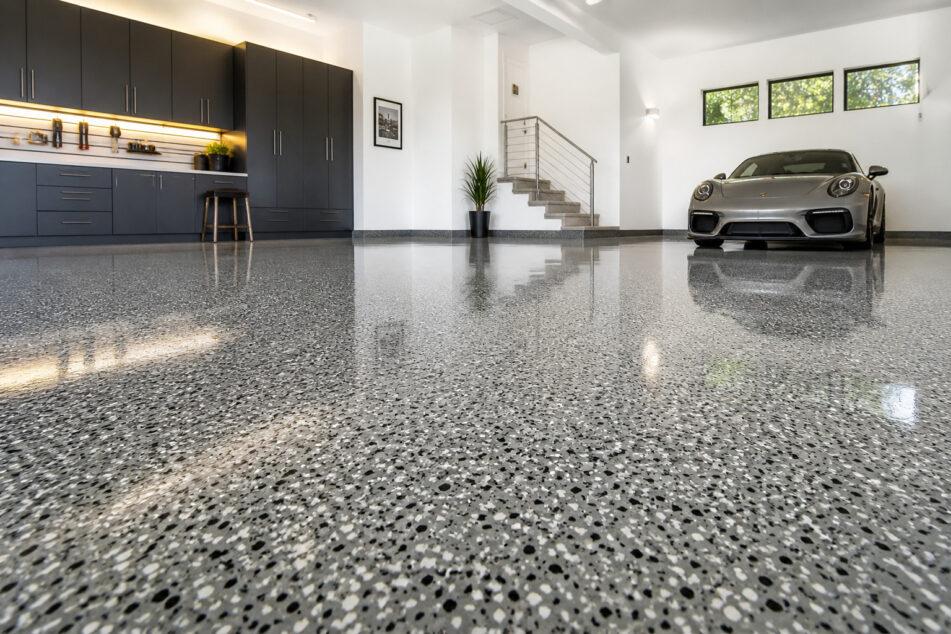
If you’ve typed “epoxy flooring Gold Coast” into Google, you’re probably standing in a garage, an alfresco, a workshop or a shop floor and wondering whether epoxy is the right surface for it. Short answer: in most of those spaces, yes — but only when it’s installed properly. Professional epoxy flooring is a multi-coat resin system laid over prepared concrete and sealed under a polyurethane topcoat. It’s not a paint, and it’s not a DIY job. Done right, it goes into residential garages and alfresco areas, and into commercial workshops, showrooms and retail floors across the Gold Coast to Redlands.
This guide covers what professional epoxy flooring actually is, where it works, the finishes available, how it’s installed, and what it costs. In twenty years on the tools, I’ve laid epoxy across hundreds of Gold Coast to Redlands slabs, and the pattern is consistent: the floors that last are the ones where the prep was done right and the system was matched to the space. That’s the lens this article is written through, and how we approach every job at Spray Your Concrete.
What Professional Epoxy Flooring Actually Is
Epoxy flooring is a two-part resin coating applied over prepared concrete in multiple layers, then sealed under a clear topcoat. The two parts — a resin and a hardener — are mixed on site and start curing the moment they meet. Once they’re down and cured, you’ve got a hard, seamless, chemically bonded surface that’s locked into the slab beneath it.
Free On-Site Quotes, Gold Coast to Redlands
We come out, look at the surface, and give you a written price. No charge, no obligation.
What I install isn’t a single product, it’s a system: a primer, a coloured basecoat, optional decorative flakes broadcast into that wet basecoat, and two coats of polyurethane sealer over the top. Each layer does a different job, and each one depends on the one underneath. What makes a floor last isn’t the resin on top — it’s the prep underneath. A perfectly mixed epoxy laid over a dirty or unsound slab will fail. The same epoxy laid over a properly ground, primed slab will hold for years.
This is a different category to the DIY epoxy paint kits sold at hardware stores — different chemistry, different prep, different lifespan, and it’s why DIY epoxy garage kits peel and lift within a year or two on a working slab. The system I use on the job is from Durable Concrete Coatings: a full professional-grade range covering primers, epoxy coatings, polyaspartic and polyurea topcoats, and the Colour Flake™ decorative flake system.
Where Epoxy Flooring Works (And Where It Doesn’t)
The short version: epoxy works in any space with a sound concrete slab where you want a seamless, chemical-resistant, easy-to-clean surface. The longer version depends on whether the space is residential, commercial, or outdoors.
Residential epoxy flooring goes into garages, alfresco areas, kitchens and wet areas. Garages are the biggest single use case on the Gold Coast to Redlands — for the full breakdown of garage floor epoxy, head to our epoxy garage flooring service page. Alfresco areas are a strong fit too, as long as the space is covered and the right topcoat is specified.
On the commercial side, we install epoxy flooring into local workshops, showrooms, supermarkets, offices and shopping centres. These spaces need a floor that handles foot traffic, wheel traffic, the occasional spill and frequent cleaning — epoxy ticks all four boxes, and the seamless finish means there are no grout lines or joints for dirt to settle into.
Outdoor applications need a caveat. Standard interior epoxy will yellow and chalk in direct Gold Coast sun within a year or two. For exterior installs — uncovered alfrescos, exposed driveways, anywhere fully out in the weather — the system needs a UV-stable polyurethane topcoat over the epoxy basecoat. Without that topcoat, you’ll be unhappy with how it looks twelve months in. Driveways are where this matters most, and professionally installed epoxy driveways are specified around that topcoat from the start.
The other honest limit is the slab itself. Epoxy won’t bond to a moving or moisture-affected slab. If the underlying concrete is cracking and shifting, or if there’s rising damp coming through, no resin will hold — that has to be fixed first. For outdoor concrete that’s structurally sound but tired-looking, concrete resurfacing is often the better call than epoxy.
Epoxy Finishes and Colour Options
Professional epoxy comes in three finish types: solid colour, metallic, and decorative flake. Each one looks different, costs differently, and suits a different kind of space.
| Finish | What it looks like | Best for | Trade-off |
| Solid epoxy | One uniform colour, sealed under a clear topcoat | Commercial spaces, plant rooms, storage — where hard-wearing matters more than decorative | Cheapest of the three, but tyre marks and scuffs show more than they do on a flecked finish |
| Metallic epoxy | Marbled, fluid pattern — no two floors look exactly alike | Showrooms, retail, feature residential areas where the floor is part of the design | Each one is hand-laid; pattern depends on how the pigment moves before it cures, so the look isn’t fully predictable |
| Decorative flake | Pigmented flakes broadcast into a wet basecoat, sealed under a clear polyurethane topcoat | Working garages, alfrescos, anywhere the floor takes daily wear and you want it to keep looking good | More expensive than solid epoxy, but hides scuffs, adds slip resistance, and gives the floor visual depth a solid colour can’t |
For a working garage, I usually recommend a flake finish — the system I install uses Colour Flake™ from Durable Concrete Coatings, with a wide selection of blends available. Final flake selection is confirmed against current stock at the on-site consultation, so you’ll see the actual samples in your hand before deciding. Our guide to decorative flake epoxy flooring explains the colour options, finish differences and installation process in more detail.
How a Professional Epoxy Floor Is Installed
Most epoxy jobs take one to two days on site. Solid epoxy is usually a one-day install; flake systems run across two days because the flakes need to cure before the topcoat goes down. After we leave, the floor takes light foot traffic in around 24 hours, and you’ll have full return-to-service in about seven days for flake systems — that’s when you can drive on it, drop tools on it, and put it back to work.
The process depends on which finish you’ve chosen. Both versions are run by our in-house team — no subcontracting — so the same crew that quotes the job is the crew that lays it.
Epoxy with decorative flakes — six steps:
- Grinding. We mechanically grind the slab with diamond tooling to open up the surface so the epoxy has something to grip. This is the single biggest reason professional epoxy outlasts a DIY kit.
- Primer. A bonding primer goes down across the prepared concrete to lock the basecoat to the slab.
- Epoxy basecoat. The coloured epoxy basecoat is rolled out across the area in your chosen colour.
- Broadcast flakes. While the basecoat is still wet, decorative flakes are broadcast into the surface by hand until the floor is fully covered.
- Vacuum. Once the basecoat has cured, loose flakes that didn’t bond are vacuumed off.
- Polyurethane sealer. Two coats of clear polyurethane sealer go over the top to lock everything in and provide UV, chemical, and wear protection.
Solid epoxy — four steps:
- Grinding. Same as above — diamond grinding to open the surface.
- Primer. Bonding primer across the prepared concrete.
- Epoxy coating. The coloured epoxy is rolled out in your chosen colour.
- Polyurethane sealer. Two coats of clear polyurethane sealer to finish.
Every job is different — slab condition, area, finish chosen, and access all affect how long the install takes and what prep is needed before the epoxy goes down. The only honest way to know what your job looks like is a free on-site quote, where we can look at the slab and tell you straight.
What Professional Epoxy Flooring Costs
Professional epoxy flooring starts from $55 per square metre for solid epoxy and from $77 per square metre for epoxy with decorative flakes. Both are starting points, not finished quotes. The actual number depends on the slab and the finish you’re after — our breakdown of epoxy flooring costs on the Gold Coast runs through the per-square-metre rates by application.
A few things move the price. A worn or oily slab needs more prep before the epoxy will bond properly. A damp slab needs moisture remediation before any coating goes down — skipping that step is the single most common cause of a failed install. Awkward spaces with cuts, columns, drains or tight access take longer to detail and finish. And the finish itself sets a floor under the price: a flake system runs more than solid epoxy because there’s an extra coat, the flakes themselves, and the vacuum step before the topcoat.
For a real number, the only way is an on-site look. We’re a licensed installer — QBCC Licence #1205294 — and the on-site quote is free.
Get a Free Epoxy Flooring Quote on the Gold Coast
If you’re not sure whether epoxy is the right call for your space, the simplest thing is to have someone come and look at it. Spray Your Concrete is a family-owned Gold Coast to Redlands business, and on-site quotes are free and no-obligation. Call 1800 954 449, or send an enquiry through our epoxy flooring service, and we’ll come out, look at the slab, and tell you straight what your job needs.

