
Concrete Pool Surrounds Gold Coast: Spraycrete & Slip Ratings
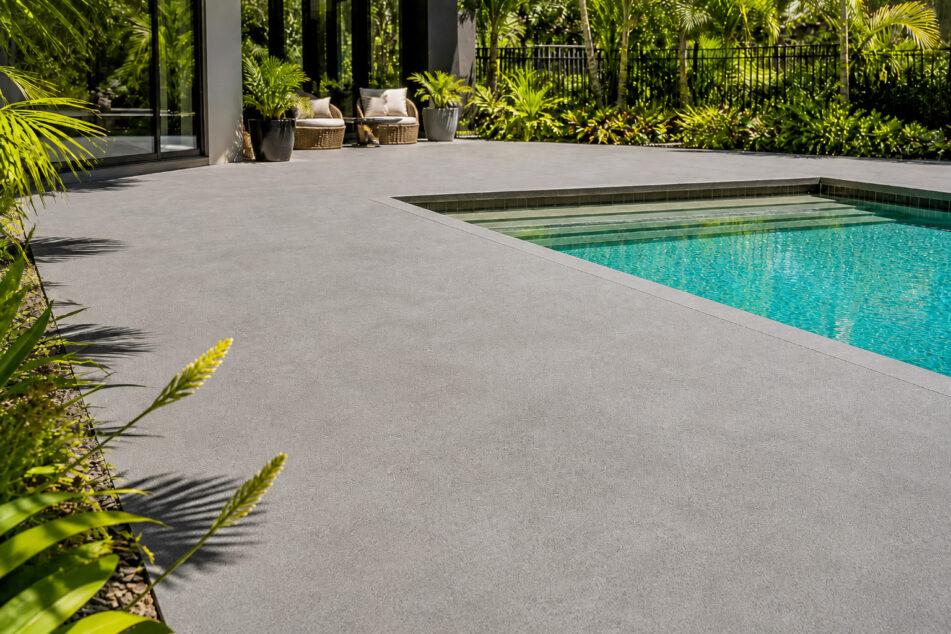
Most Gold Coast pool surrounds get judged on a January afternoon, barefoot. The two questions a homeowner is actually trying to answer before they pick up the phone are whether the surface will be too hot to walk on and whether it will be slippery when wet. Everything else — colour, finish, pattern — sits underneath those two.
Spraycrete around a pool can handle both, but only if it’s specified properly. Get the colour, the slip rating and the sealer right and you end up with a concrete pool surround that’s comfortable underfoot in full sun and grippy when the kids climb out dripping. Get any one of those wrong, and you’ve got a problem you’ll be living with every summer.
This article walks through what to ask for — and what to avoid — when you’re putting a new finish on concrete pool surrounds on the Gold Coast or Redlands.
Free On-Site Quotes, Gold Coast to Redlands
We come out, look at the surface, and give you a written price. No charge, no obligation.
What ‘Slip-Resistant’ Actually Means Around a Pool
Most contractors will tell you a coating is slip-resistant. Fewer will tell you what rating it carries, and that’s the part that matters around a pool. In Australia, wet-surface grip is measured using the pendulum test, which classifies a finish from P0 through P5 — P5 is the highest grip rating and the classification typically specified for wet, high-risk areas where people walk in bare feet. Pool surrounds sit squarely in that category.
For non-stencil pool surrounds, we use Shieldcoat’s Step Safe Heavy Duty — an acrylic concrete coating that carries a P5 anti-slip rating. The acrylic resin is also colour-fast and fade-proof, which matters for an unshaded pool surround copping full sun for half the year. That’s not every product on the market. Plenty of slip-resistant concrete coating around pool jobs sit at P3 or P4, which is fine for a covered patio, but isn’t what you want on a wet surface where kids are climbing out of the water in bare feet. The texture you choose plays into the grip, too — a rougher splatter texture gives a pool deck more bite underfoot, which is why it’s the usual pick for wet areas. If you’re getting quotes for a non-slip pool surround on the Gold Coast from any contractor, the question to ask is straightforward: what’s the P5 anti-slip rating on the coating you’re putting down, and where’s it documented?
If you’ve already decided resurfacing is the direction, our pool surround resurfacing service lays the spec out in full.
How to Choose Pool Surround Colours That Stay Cool Underfoot
The single biggest factor in whether a pool surround is comfortable underfoot in summer isn’t the texture or the sealer — it’s the colour. Darker concrete absorbs heat from direct sun, which pushes the surface temperature up sharply on a still January afternoon. Lighter concrete reflects more of that heat. On a Gold Coast pool, where the surround is in full sun for most of the day from October through to March, that difference is the gap between barefoot being fine and barefoot sprinting for the grass.
This is the cool-deck principle, and it matters more here than almost anywhere else. North- and west-facing pools cop the worst of it — full afternoon sun straight onto the surround in the December/January peak. If your pool sits in either of those orientations and isn’t shaded, a heat reflective pool surround in a pale tint is the safer call.
Out of the Step Safe Heavy Duty range, the concrete pool surround colours I’d point you toward for an unshaded surround are Calm, Southerly, Stone, Paperbark and Dune. Any of those light-reflective colours will sit measurably cooler underfoot than a charcoal or a deep grey on the same afternoon. Mid- and dark-greys still have their place, but you should know what you’re trading:
- Pale tints (Calm, Stone, Dune and similar): noticeably cooler underfoot in full sun, but show pool-water staining and dropped suncream more visibly.
- Mid- and dark-greys (charcoals, slate tones): photograph beautifully and hide marks well, but get hot underfoot on a north- or west-facing surround in summer.
- Stencilled concrete pool surrounds: the same colour-selection logic applies, just within the Dulux Avista range we use for stencil work — same P5-grade slip performance, different aesthetic.
Neither pale nor dark is wrong — it’s about your pool, your aspect and your tolerance for cleaning. The colour decision is the single thing I’d put the most thought into before quoting day. We’ll walk through it on-site, and there’s also a more general piece on how to choose a colour and design that goes deeper on the design side.
How the Sealer Holds Up to Chlorine and Salt
Every spraycrete pool resurfacing job finishes the same way — two coats of clear sealer over the colour. On a driveway, that sealer is mostly fending off UV and dropped oil. On a pool surround, it’s working a lot harder. The same surface is copping UV, chlorine splash from kids climbing out wet, and on a salt-chlorinated system, fine salt spray that lands on the surround every time the water moves. The sealer is the layer holding all of that off the colour underneath, and getting it right matters.
The sealer that goes on top of Step Safe Heavy Duty is a water-based system designed to bond properly with the acrylic coating underneath and hold up to outdoor exposure. It’s built for UV stability, chlorine resistance and salt spray — which is exactly what an unshaded Gold Coast or Redlands pool surround throws at it, particularly on anything salt-chlorinated. Two coats of clear go down at the end of the job to lock in the colour and the P5 anti-slip rating underneath.
That bonded sealer pairing is also what keeps the Shieldcoat seven-year manufacturer warranty intact — using the wrong sealer on top of the coating breaks the system. The question to ask any contractor quoting on a spraycrete around pool job is straightforward: which sealer are you using, and is it the one the coating manufacturer actually recommends — the one that holds the colour-fast finish?
When Spraycrete Around Pools Isn’t the Right Fix
Spraycrete pool surrounds fix many problems, but they aren’t the right answer for everything. The sealer and the coating only do their job if what’s underneath is sound. There are three scenarios where I’ll tell a homeowner straight that a resurface isn’t worth doing — at least not until something else gets sorted first.
- The slab is moving. Visible movement cracks running through the surround, settling at one end, or heave from tree roots underneath. A hairline crack is fine — coatings handle those. But if the substrate itself is shifting, no coating will hold. That needs to be diagnosed and the slab stabilised before any spray goes down.
- There’s no fall-to-drain, or the drainage is wrong. If water sits against the coping after a swim or a storm, you’ve got a drainage problem, not a coating problem. Resurfacing won’t fix it — and laying a fresh coat over standing-water issues just hides the problem until it eats through. Fixing the fall, the expansion joint detailing, or the drainage path comes first.
- The existing surface is heavy tile. Going from tile straight to a thin spray-applied finish is possible, but it’s a different conversation — our pool surround restoration guide walks through the substrate paths properly.
The on-site quote is a free assessment, not a sales call. If it’s not worth doing, I’ll say so.
How We Resurface a Concrete Pool Surround, Step by Step
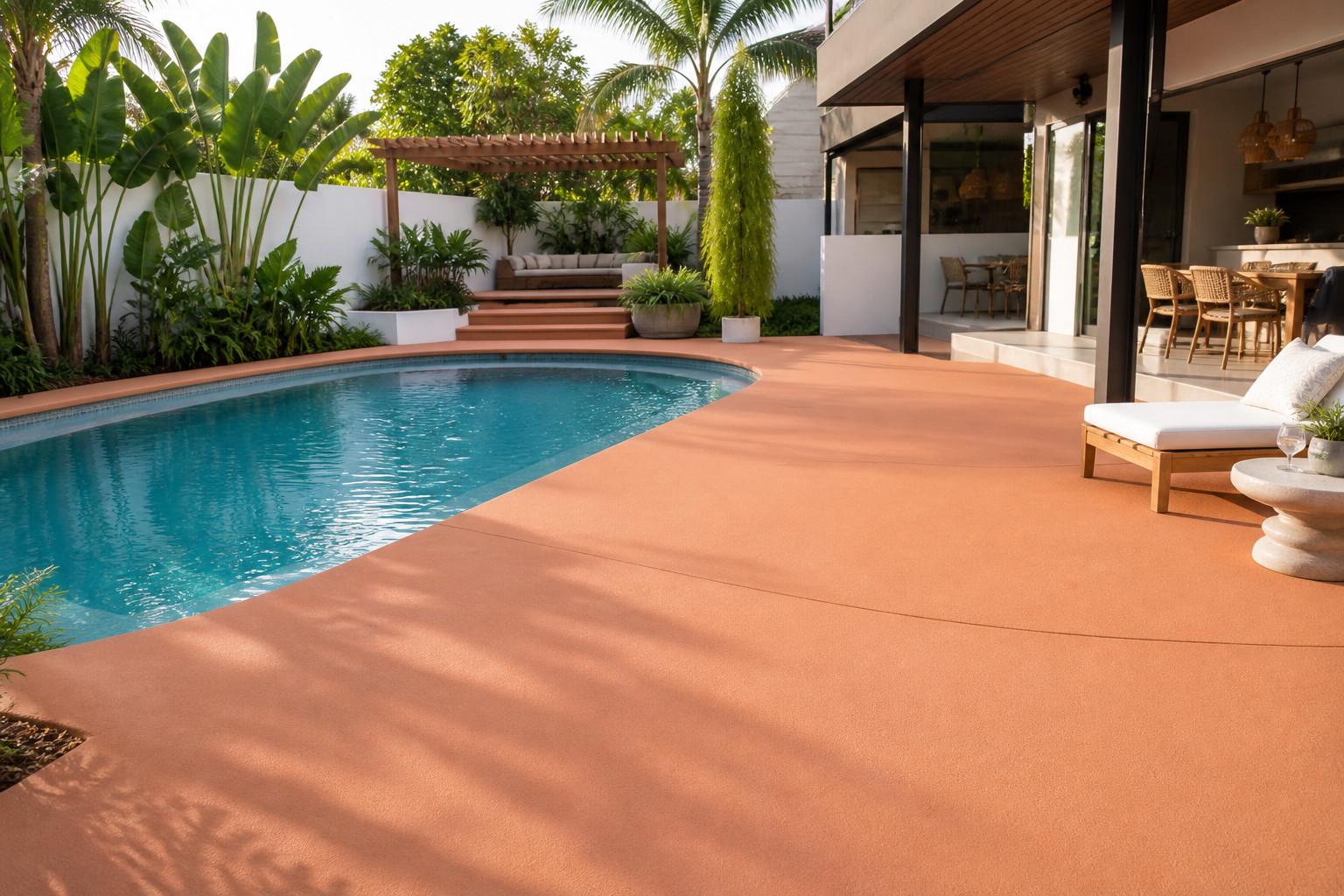
If your slab is sound and the spec is right, the install itself is straightforward — but it’s a five-stage job, not a one-day spray-and-go. Here’s how a typical spraycrete pool surround job comes together over two to three days, weather permitting
- Pressure wash. The existing slab gets a thorough pressure wash to strip off dirt, oils, sunscreen residue and anything that would stop the coating bonding. This is also where we get a proper look at the surface and pick up anything that needs attention before coating starts.
- Crack repair. Hairline cracks and minor surface damage on the existing concrete are filled and patched. Movement cracks are a different conversation (covered earlier) — these are the surface-level cracks that a coating will sit comfortably over once they’re sorted.
- Bonding primer. A primer goes down across the prepared slab to lock the coating to the substrate. Skip this and the coating won’t hold long-term, no matter how good the product is.
- Three coats of Step Safe Heavy Duty. The team applies three coats of the coating in the agreed colour, roller-applied for an even build. Cure time between coats matters — pushing the schedule here is one of the fastest ways to end up with adhesion problems down the track.
- Two coats of clear sealer. The job finishes with two coats of clear sealer to lock in the colour and the P5 anti-slip rating underneath.
While the work’s on, you’ll need to keep the area clear and plan around the cure window — no foot traffic, no pool use until the sealer’s fully set. Most residential pool surrounds are finished inside two to three days, with size and weather the two variables that move that.
Frequently Asked Questions
Get a Free Quote on Your Gold Coast Pool Surround
Getting a pool surround right around here isn’t complicated, but it does come down to three things: the right system for the conditions, a colour that suits your aspect, and a sealer that holds up to chlorine and salt. Get those calls right, and the surround stays cool, grippy and good-looking for years. Get any of them wrong, and you’ll know about it every summer.
Spray Your Concrete is a family-owned, QBCC-licensed business (Licence #1205294) that’s been creating spraycrete pool surrounds on the Gold Coast to Redlands since 2012. We do free on-site quotes — and if a resurface isn’t the right call for your slab, we’ll tell you straight. Have a look at pool surround resurfacing on the Gold Coast or call us on 1800 954 449 to book a time.

